



 Ukraine reports 5,276 new COVID-19 cases
 Zelensky: Every third Ukrainian considers road construction one of greatest achievements of 2021
 Ukraine ready to implement Minsk agreements, but Russia's desire needed - Yermak
 Michel: EU unanimously agree to roll over economic sanctions against Russia
 Actions by Ukraine's partners will help prevent worst-case scenario - Zelensky
 COVID-19 in Ukraine: Health officials confirm 8,899 daily cases as of Dec 17
 Macron tells Zelensky he declared support for Ukraine in call with Putin
 Zelensky, Scholz discuss gas transit through Ukraine after 2024
 Ukraine ready for any format of talks with Russia - Zelensky
 Ukraine’s only journalist in Russia facing extremism charges - lawyer
 PM Shmyhal: First two applications for investment projects worth $96 million filed
 Zelensky, PM of Italy discuss security situation around Ukraine
 President signs off State Budget 2022
 London considering all options for responding to Russia's aggression against Ukraine
 Putin, Biden to hold another round of talks
 Some 260,000 Ukrainians “victims of human trafficking” over 30 years - prosecutor general
 Ukraine plans to create center to protect energy infrastructure from cyber attacks
 No clear idea so far when Normandy Four top diplomats set to meet - German Ambassador
 Ukraine receives EUR 600M in macro-financial assistance from EU
 Zelensky holds phone conversation with PM of Israel
 Ukraine sets new daily COVID vaccination record
 MFA: European Union has not yet removed Ukraine from list of safe countries
 Kyiv records 1,023 new COVID-19 cases, 29 deaths
 G7 ambassadors welcome adoption of law on NABU status
 Ukraine can increase Covid vaccination rates to 1.5M a week – Liashko
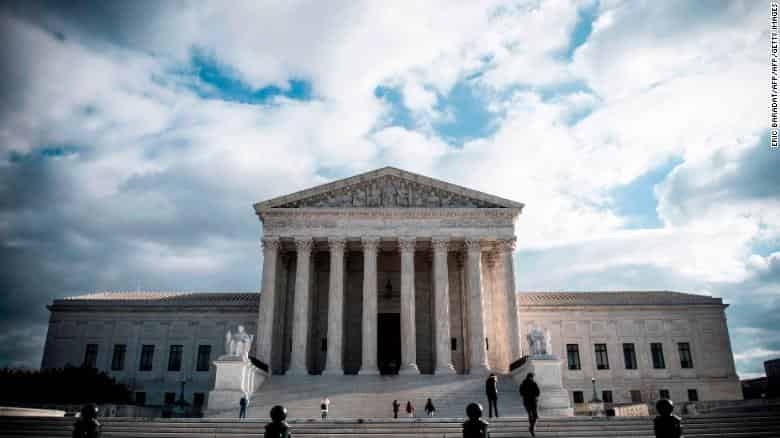
The Supreme Court will delve into the issue of racial gerrymandering Monday when the justices review a lower court opinion that struck down Virginia district maps as a violation of the Constitution.
At issue are 11 maps drawn by the House of Delegates in 2011 that were successfully challenged by registered voters in each district.
"The Equal Protection Clause ensures that states do not engage in the offensive and demeaning assumption that voters of a particular race, because of their race, think alike, share the same political interests, and will prefer the same candidates at the polls," a panel of federal judges ruled last June.
The case -- which has been tangled in the courts for years -- comes on the eve of the next census, after which new maps will be drawn. As such, the justices' ultimate opinion won't have a lasting impact on the current maps but it could influence how states draw maps in the future.
It's the second time the justices have reviewed the case. Two terms ago, the justices upheld one district but asked the lower court to reconsider whether race was used improperly in the remaining 11.
Unlike the issue of partisan gerrymandering, the Supreme Court has settled on a standard to determine when states go too far in considering race. The court has said that if race is the predominate factor in drawing lines, then the use of race has to be narrowly tailored to advance a compelling governmental interest.
After fresh review and a new trial, the lower court held that the plaintiffs "have shown through telling direct and circumstantial evidence that race predominated over traditional districting factors."
Registered voters from each district, represented by election law expert Marc Elias, who served as the general counsel for Hillary Clinton's 2016 presidential campaign, argued that "African-American voters were moved in the challenged districts at a higher rate than white voters, Democratic voters, and the population as a whole -- and moved out at a lower rate than all these groups."
The consequence of the maps, Elias argued in court papers, was that African-American voters were crowded into the districts at issue so that their votes were diluted in surrounding areas.
The Legislature sought to achieve an African-American voting age population of at least 55% in each district.
In briefs, Elias said the House of Delegates had imposed a "nonnegotiable" 55% black voting age population floor "across the board" despite the districts being "very different."
In striking the maps, the lower court held that the Legislature "made no effort to determine whether the mechanical 55% racial threshold was required to comply with the VRA (Voting Rights Act), and instead arbitrarily applied the same racial mandate" to "vastly" dissimilar districts.
"The district court made extensive fact finding and followed the Supreme Court's instruction on how to deal with this to a 'T,' consistent with how the court has ruled in every racial gerrymander that has come before it this decade," said Allison Riggs, a staff attorney at the Southern Coalition for Social Justice who supports the challengers.
But a lawyer for the House of Delegates argued that the lines had been drawn utilizing traditional redistricting factors including compactness, contiguity and a respect for political subdivisions.
In addition, when the maps were drawn, Virginia was a covered jurisdiction under the Voting Rights Act that mandated the Legislature draw maps that would not result in retrogression of a minority group's ability to elect its preferred candidate.
Paul Clement, a lawyer for the House, argued that legislators "widely agreed" that targeting a 55% African-American voting age population would best prevent retrogression. Clement said the Justice Department had precleared the map, which was used for the next two elections and was challenged only after a Democratic governor was sworn in.
Clement argues that the legislation is "walking the tightrope" between the Constitution, which restricts the consideration of race in the redistricting process, and the Voting Rights Act, which "often insists that districts be created precisely because of race."
One issue that might stop the justices from getting to the merits of the case is whether the House has the legal right or "standing" to bring the case in the first place.
The Trump administration argues the House does not have standing because a Virginia law says that only the state's attorney general has the right to bring the suit. The attorney general, a Democrat, elected not to seek an appeal.
The government argues, however, that if the Supreme Court were to reach the merits of the case it should vacate the lower court opinion.






 Следите за нами в Facebook