



 Ukraine reports 5,276 new COVID-19 cases
 Zelensky: Every third Ukrainian considers road construction one of greatest achievements of 2021
 Ukraine ready to implement Minsk agreements, but Russia's desire needed - Yermak
 Michel: EU unanimously agree to roll over economic sanctions against Russia
 Actions by Ukraine's partners will help prevent worst-case scenario - Zelensky
 COVID-19 in Ukraine: Health officials confirm 8,899 daily cases as of Dec 17
 Macron tells Zelensky he declared support for Ukraine in call with Putin
 Zelensky, Scholz discuss gas transit through Ukraine after 2024
 Ukraine ready for any format of talks with Russia - Zelensky
 Ukraine’s only journalist in Russia facing extremism charges - lawyer
 PM Shmyhal: First two applications for investment projects worth $96 million filed
 Zelensky, PM of Italy discuss security situation around Ukraine
 President signs off State Budget 2022
 London considering all options for responding to Russia's aggression against Ukraine
 Putin, Biden to hold another round of talks
 Some 260,000 Ukrainians “victims of human trafficking” over 30 years - prosecutor general
 Ukraine plans to create center to protect energy infrastructure from cyber attacks
 No clear idea so far when Normandy Four top diplomats set to meet - German Ambassador
 Ukraine receives EUR 600M in macro-financial assistance from EU
 Zelensky holds phone conversation with PM of Israel
 Ukraine sets new daily COVID vaccination record
 MFA: European Union has not yet removed Ukraine from list of safe countries
 Kyiv records 1,023 new COVID-19 cases, 29 deaths
 G7 ambassadors welcome adoption of law on NABU status
 Ukraine can increase Covid vaccination rates to 1.5M a week – Liashko
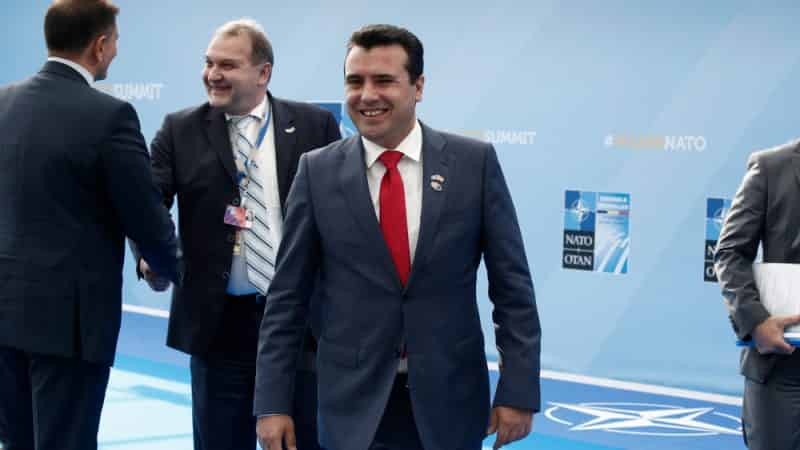
In a symbolic gesture, the Greek government will most probably be the first country to ratify North Macedonia’s NATO accession protocol, as it aims to do it by 8 February, sources close to the issue told EURACTIV.com.
On 28 January, a NATO spokesperson said the date for signing the accession protocol of the 30th member of the alliance would be determined “in the coming days”, after Athens and Skopje both ratified a historic deal that ended their 27-year-old dispute in January, which has so far blocked Skopje’s efforts to join NATO and the EU.
This practically means that North Macedonia could become a NATO member at the July summit if the rest of NATO allies speed up the ratification procedures as well. Normally the ratification process takes a year.
According to sources, the official text of the accession protocol was approved yesterday and the 29 NATO permanent representatives are now waiting for authorisation from their countries to sign it.
Once it is signed, it will be sent to the 29 capitals to be ratified by the national parliaments.
“Greece wants to ratify the accession protocol by 8 February,” the source said, adding that Athens will probably be the first country to open the NATO doors for North Macedonia.
The biggest prize
North Macedonia’s Prime Minister Zoran Zaev and his Greek counterpart Alexis Tsipras were nominated by the leaders of three EU parliamentary groups – Socialists and Democrats (S&D), Greens and United European Left-Nordic Green Left (GUE-NGL) – for a Nobel Peace Prize.
No chance for negotiation
Reljić explained that the Prespa agreement could help southeast Europe look to a more stable future while future attempts to “re-negotiate” the agreement were bound to fail.
“One can certainly expect that there will be attempts in both countries, should governments change, to renegotiate the agreement, but such an effort would probably be doomed to fail, also because of important interests in the West not to permit a roll-back,” the analyst said.
The main Greek opposition party, New Democracy, voted against the name change deal in the Greek parliament and has vowed to do the same about the NATO accession protocol.
“Western states and the US are concerned to secure stability at NATO’s southeast flank, particularly as it is difficult to predict the future trajectory of Turkey under President Erdoğan. So Northern Macedonia and the Prespa agreement are of much broader relevance than only between Skopje and Athens and will, therefore, most probably, endure,” Reljić said.
Prespa will establish peace in Macedonia
Another crucial parameter of the Prespa deal, according to Reljić, is that North Macedonia’s membership in NATO will be the most important barrier to a conceivable disintegration of that country because of the persistent ethno-political conflicts between Albanians and Macedonians.
“Albania is already in NATO and has to respect the territorial integrity of other member states. However, the drive to create a unified Albanian political, economic and cultural space encompassing Albania itself, Kosovo, parts of Serbia and also of the Republic of North Macedonia has become stronger in the recent past,” the analyst said.
Reljić said Albanian President Edi Rama was presently at the helm of such strategies, which he seems to be pursuing in anticipation of a deal between Serbia and Kosovo, possibly involving a new demarcation of borders.
In a TV interview yesterday (28 January), Nikos Kotzias, the former Greek foreign minister and the man behind the Prespa deal on the Greek side, highlighted the role of ethnic-Albanian Ali Ahmeti, leader of the Democratic Union for Integration.




 Следите за нами в Facebook